

Written by Samira Ahsan
What does adaptability mean in a landscape shaped by loss?
When we speak of adaptability, we talk about more than material flexibility. We mean an architecture that responds to water, to livelihood, to loss, and return.
In response to the dynamic deltas of Bangladesh, architecture can no longer be a static dream rather, it must adapt to the shifting landscape.
As the world’s seventh most climate-vulnerable nation, the country faces intensifying riverbank erosion, increasingly unpredictable rainfall, and monsoon surges that redraw its geography with every passing year. Around 25,000 people are displaced annually by river erosion, and more than 70% of the land sits less than one metre above sea level.
In such a reality, as millions contend with fluctuating ground beneath their feet, the idea that a home might stay put like a monument to permanence feels antiquated.
–
Speaking about displacement across Bangladesh’s riverine regions, Architect Marina Tabassum has repeatedly framed mobility as a lived condition rather than a design choice: “People are forced to move repeatedly. They need homes they can carry with them.”
–
How did a practice born of necessity become a commercial phenomenon?
Long before modularity entered global architectural discourse, communities across the Ganges–Brahmaputra delta were already practising it out of necessity.
What emerges here is a form of vernacular prefabrication.
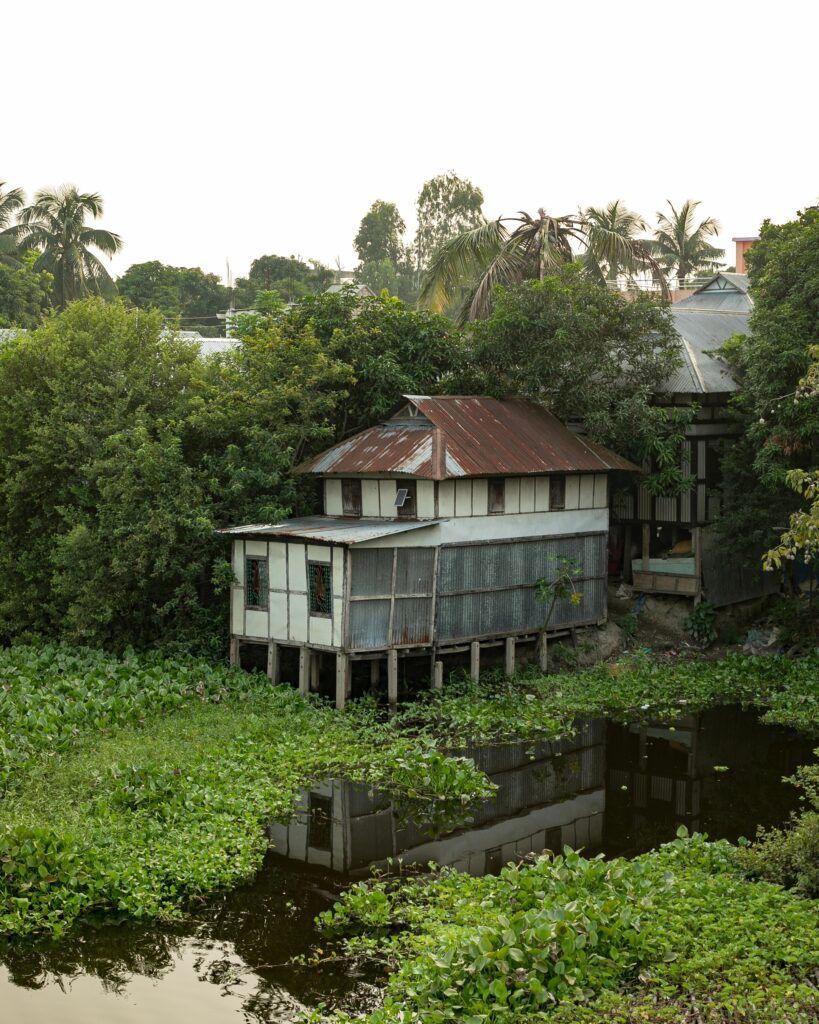
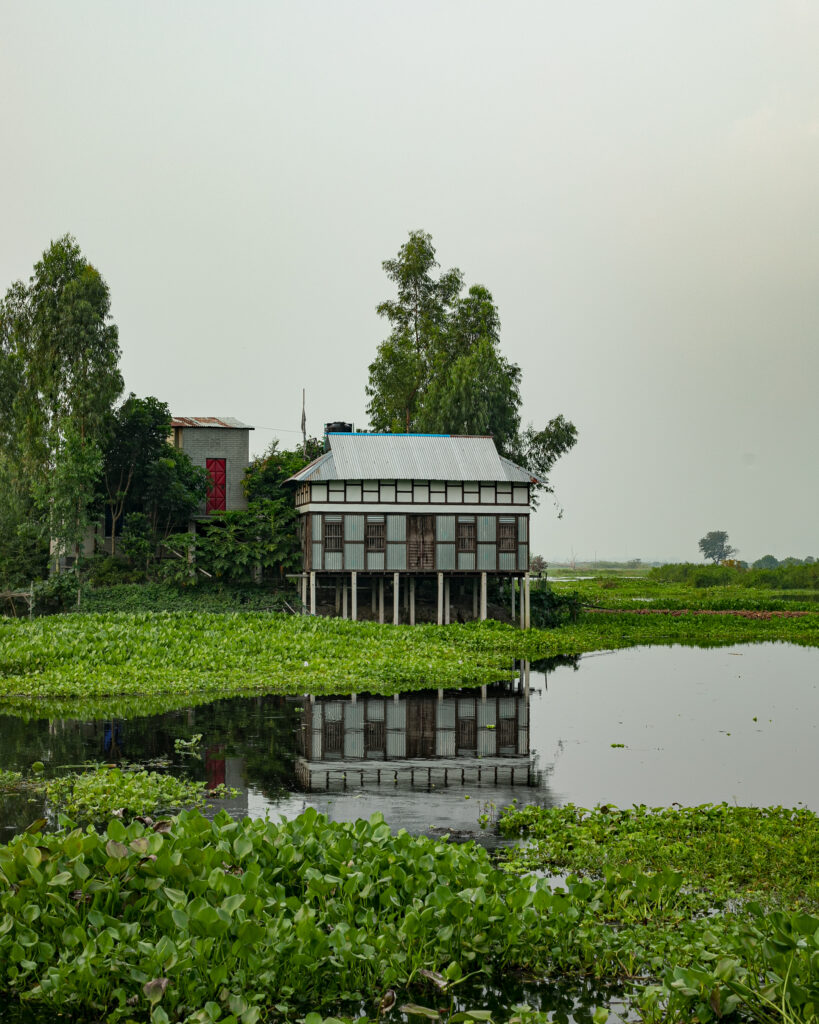
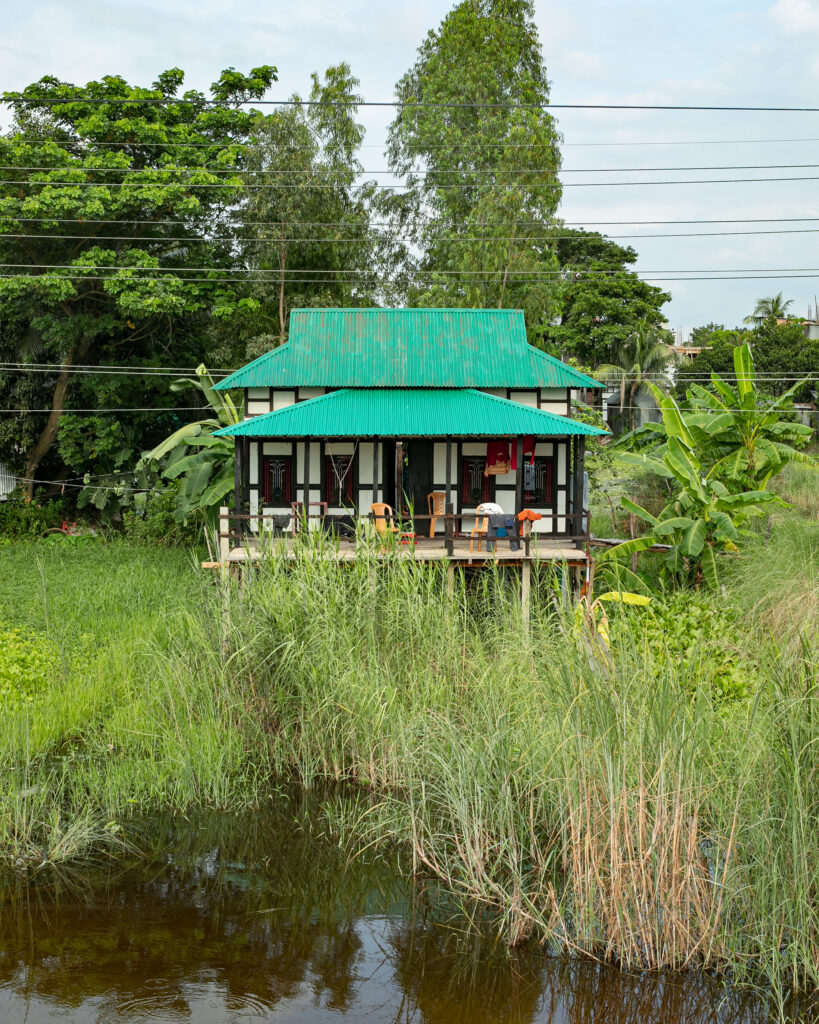
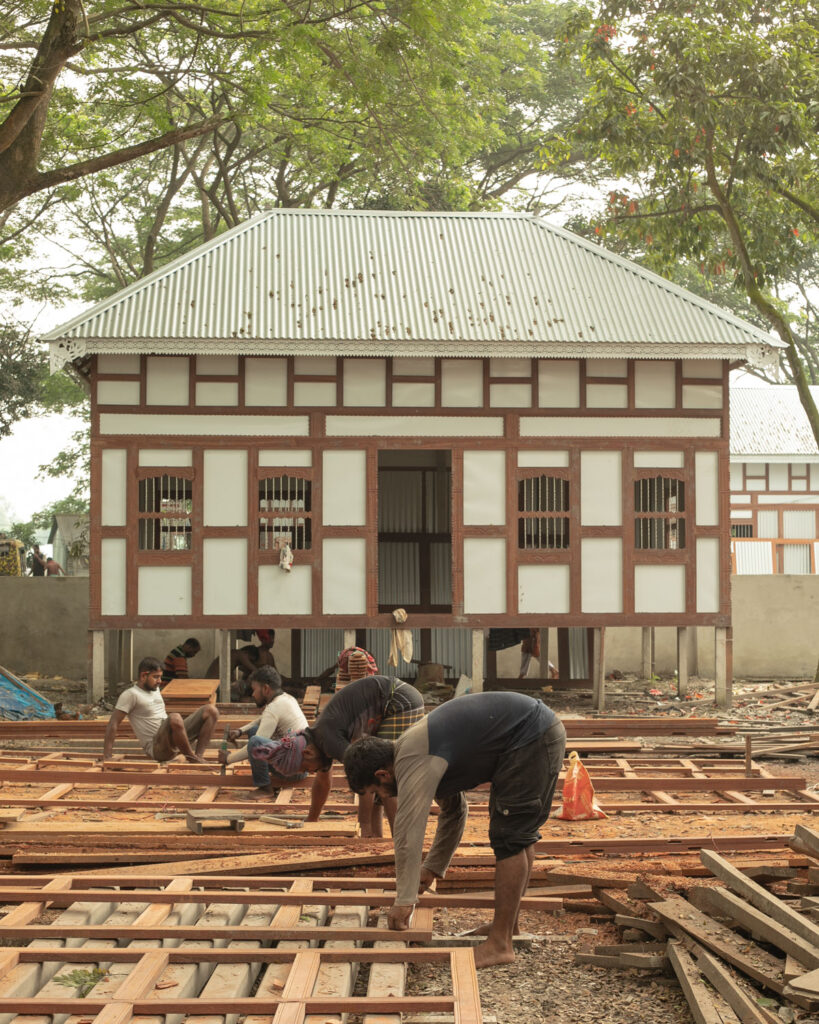
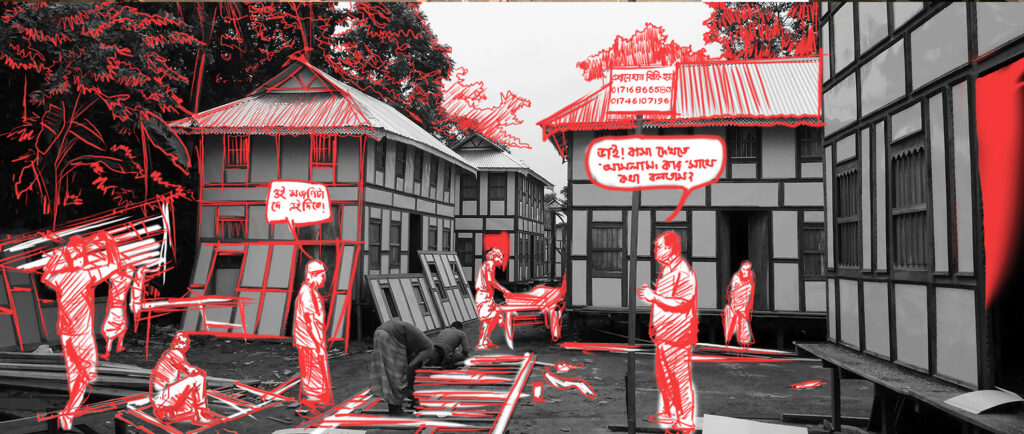
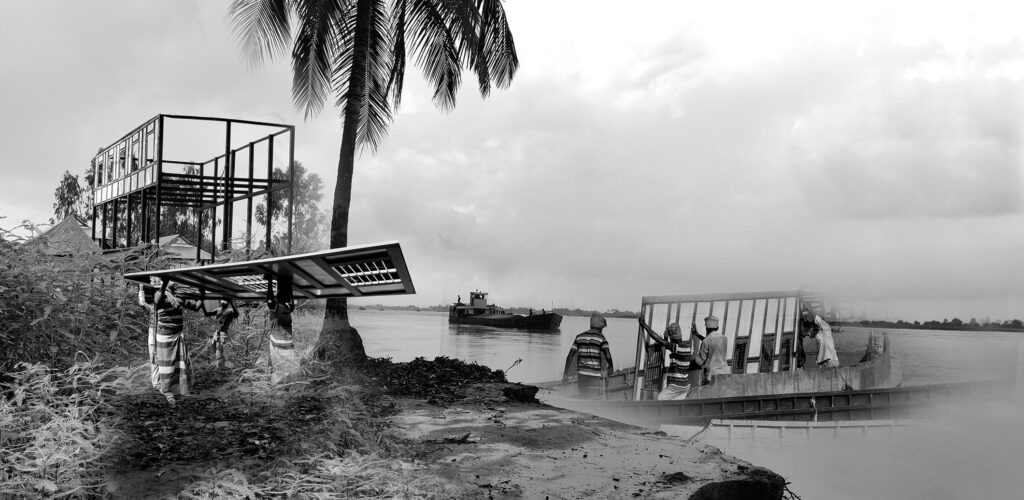
If anyone asks, why do Munshiganj’s portable houses stand apart or what really distinguishes these houses? The answer is not just the concept of mobility itself, but the comprehensive ecosystem that supports it. This includes dedicated markets, commonly known as “Ghorer Hat,” that translates to “A market of homes,” that produce ready-made houses by artisans who specialize in modular timber joinery, with the capacity to disassemble a house in just a few hours, and a supply chain that is tailored for both road and water transport.
Architectural researcher Humayra Anan, who spent months documenting the builders and buyers of Ghorer Hat, shows that these are not isolated carpenters improvising solutions. They operate as a shared knowledge system, refining designs through repetition, memory, and intergenerational craft. What emerges is a building culture that is, in many ways, more agile and adaptive than many formal housing schemes.
“‘Ghorer Hat’ has evolved from years of dialogue shared between local artisans and affected communities in response to persistent environmental threats. In a context where displacement is the sole reality of existence, these prefabricated dwellings promise progress and enable local communities to preserve their cultural identity,” shares Humayra.
–
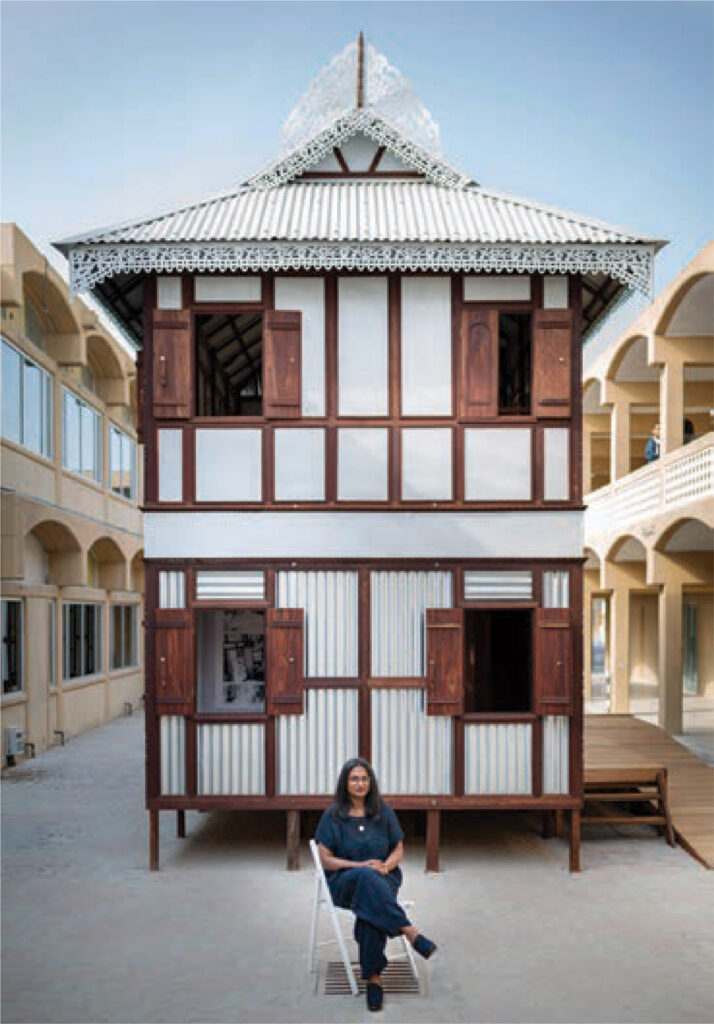
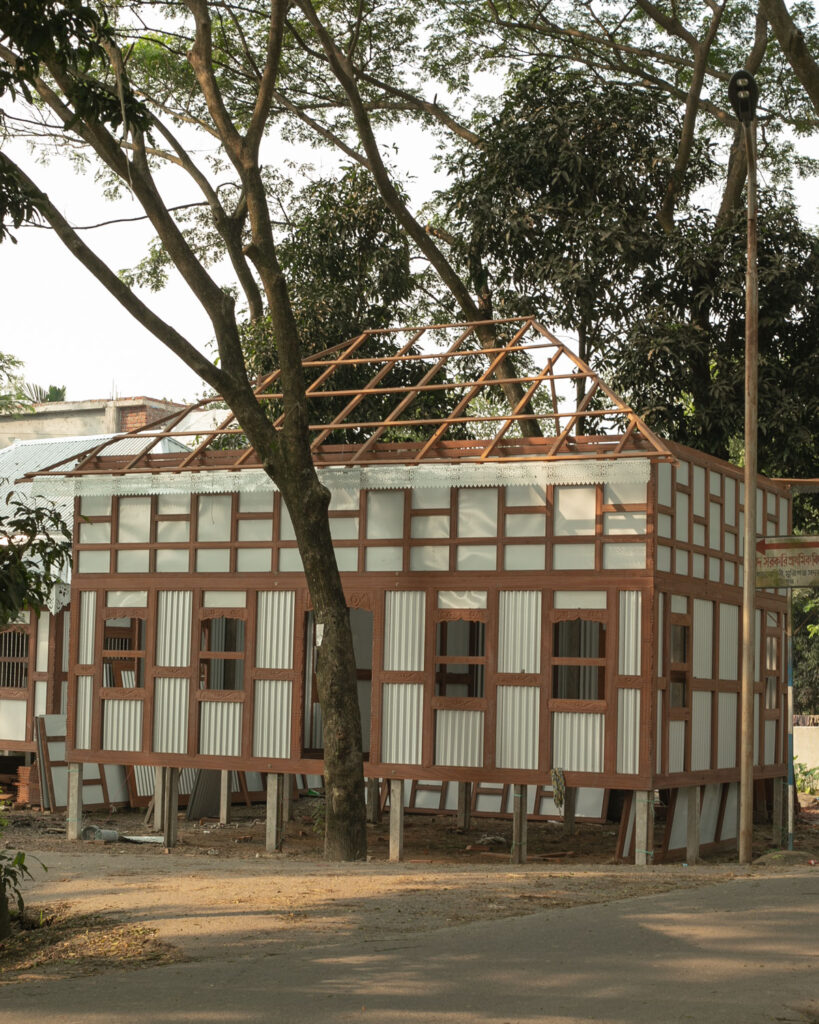
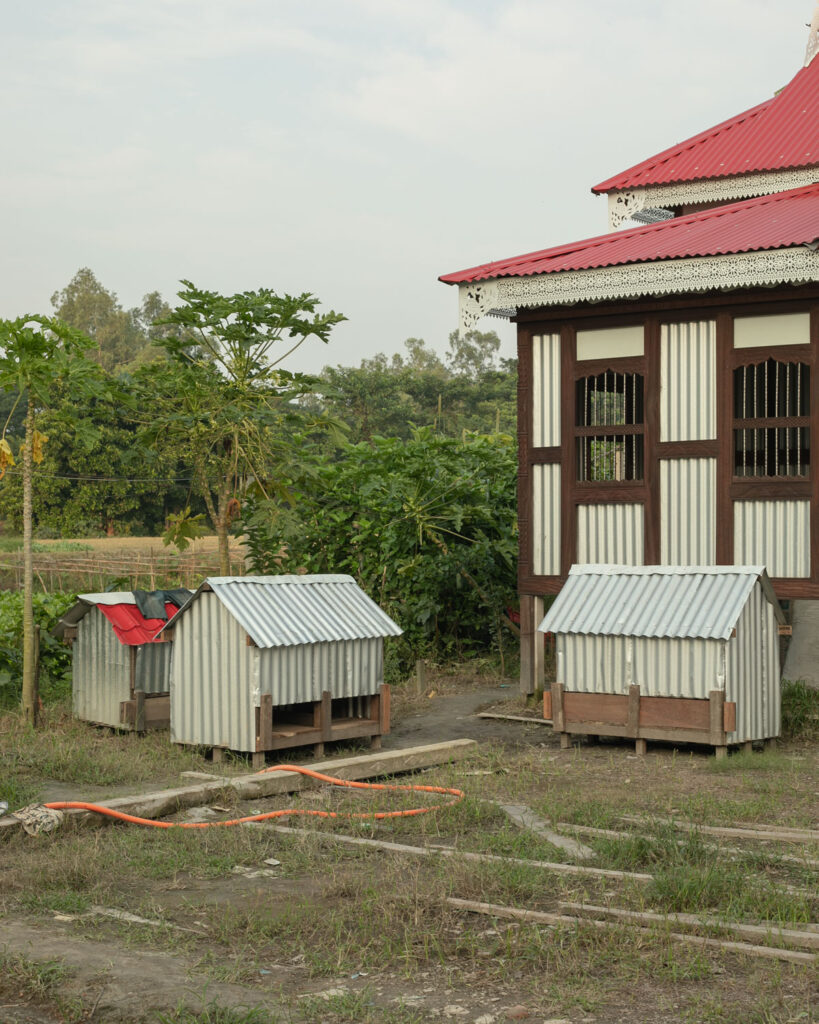
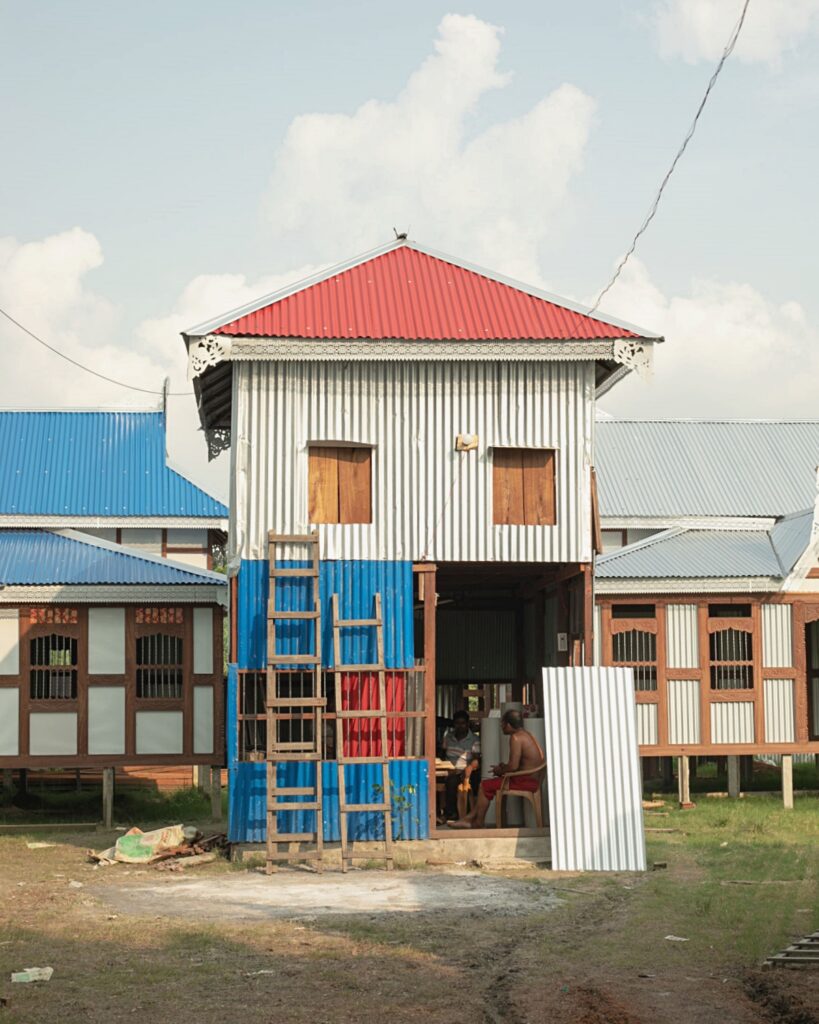
Portable wooden houses have existed across Bangladesh’s deltaic regions. Yet the houses of Munshiganj have become iconically recognisable — their blackened timber frames and white tin skins forming a visual identity that now circulates far beyond the district.
Why did the houses become ornate?
The ornamentation within the houses is a layered cultural response to precarity.
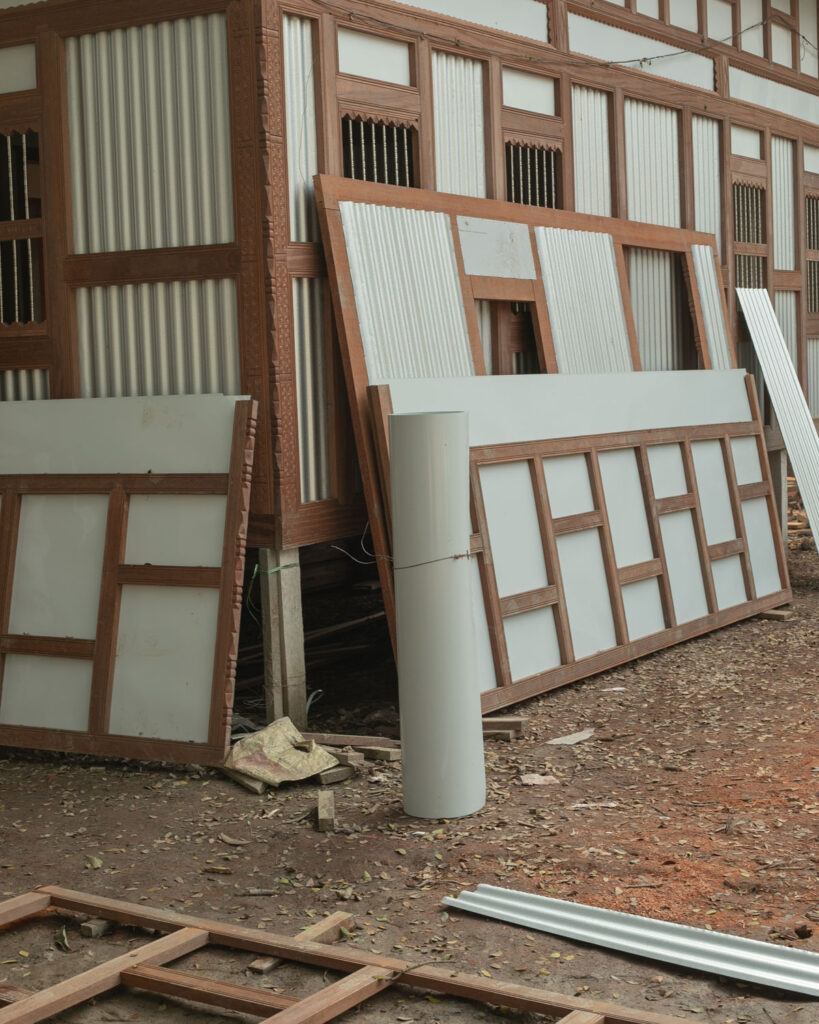
Artisans now carve intricate decorative patterns into doors, frames, and balustrades, turning what was once a purely functional shelter into something closer to a crafted object—part house, part artifact. In this evolution, the houses have begun to oscillate between necessity and aspiration.
But here, adaptability is an everyday necessity instead of an abstract design ambition. The homes are modular because land is uncertain, and the structures are lightweight because the future is unpredictable.
Therefore, Ghorer Hat is not simply a market of houses. It reflects the side of architecture that quietly questions long-held assumptions about permanence, ownership, and what it means for a building to endure.
As climate instability increases, mobility becomes a necessity but aspiration does not recede. The carvings on doors, balustrades, and window frames serve several purposes:In uncertain conditions, ornamentation acts as a claim to beauty and self-respect.
A house in motion does not need to be plain.
The motifs echo older woodcraft traditions of Bikrampur and Bengal more broadly. Ornament stabilises identity when land does not. As the market grew, artisans differentiated their houses through craftsmanship. To a losing land, a carved door becomes an heirloom, that too, a door that can travel beyond its place.
–
What does modularity look like in practice?
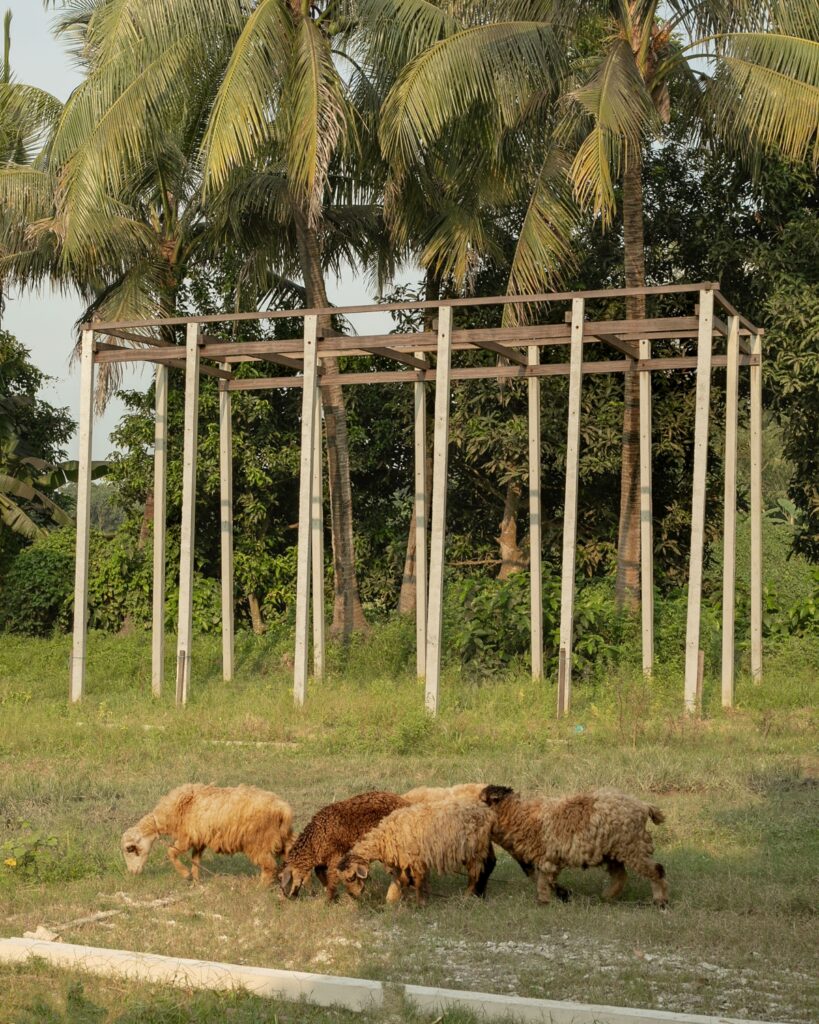
For Munshiganj’s builders, modularity is a routine. The houses are assembled with pegged joinery, repeatable dimensions, and components that can be carried, loaded, lifted, or replaced. Timber circulates through cycles of repair and reassembly, embedding material reuse into everyday practice.
However, modularity here primarily supports movement, not expansion. While houses can be dismantled and relocated with relative ease, their size typically remains fixed; when families grow, they tend to acquire additional units rather than extend a single structure. While the houses are modular in how they are assembled and relocated, their size typically remains fixed; households expand by acquiring additional units rather than extending a single structure.
In her research, Humayra Anan proposes a modified construction system that builds on this logic. Her observations highlight a system that introduces incrementally expandable units, translating an existing vernacular system of mobility into one that also accommodates growth and extends the possibilities of this vernacular model.
Repairs, meanwhile, are local and incremental, supported by a culture of maintenance that reinforces both sustainability and community knowledge. Modularity in this context is intuitive rather than diagrammatic. In such settings, the architect’s role shifts from author to facilitator, translating local intelligence into systems communities can continue to adapt over time.
A carpenter from the Ghorer Hat market explained:
“We don’t need new materials every time. The old pieces fit again.”
This is, functionally, circular economy, long before the term entered design vocabulary.
–
Is this unique to Bangladesh, or part of a wider South Asian vernacular intelligence?
Elements of modularity appear across South Asia — bamboo stilt houses in Assam, raised wooden houses in Nepal’s floodplains, and modular timber frames in Myanmar. But nowhere in the region is there a commercial market equivalent to Munshiganj’s readymade house bazars, where hundreds of houses are built on-site, displayed, customised, dismantled, and shipped nationwide.
In the context of Bangladesh, one of the world’s largest and most dynamic deltas, this practice has evolved into a logic that is both vernacular and infrastructural. It reflects a long tradition in the subcontinent.
On informal settlements and self-built urbanism, B.V. Doshi often spoke about the value of self-construction and participatory architecture, particularly in “Aranya” and informal housing research. Doshi viewed self-built environments as “living organisms,” evolving through time, shaped by circumstance, and continuously remade.
Globally, similar principles appear in Shigeru Ban’s disaster-responsive shelters, which emphasise systems that are “easy to assemble, easy to dismantle,” using materials people can access and repair themselves.
The global architectural community continues to experiment with modular or “flat-pack” models, yet the systems authored locally in Munshiganj often outperform high-tech prototypes in efficiency, affordability, and cultural fit.
–
What can this teach global architectural discourse?
The houses of Munshiganj are not merely prototypes. They are lived, inherited, transported, and modified. They carry a sense of belonging. They remind us that climate-resilient architecture does not always require high-tech solutions. Sometimes it requires listening to landscapes, to craftspeople, to histories of movement.
The future of adaptable design may not be invented in laboratories; it may already exist in places like Ghorer Hat, where homes are not rooted to land but rooted to people.
The larger imperative is that Bangladesh’s climate vulnerability is not a distant forecast but a present condition: swelling rivers, stronger monsoon pulses, and rising seas already reshape where and how people live.
Seen this way, Munshiganj’s portable houses are not merely responses to the crisis. They are propositions for a different architectural future, one in which mobility, modularity, and continuity co-exist.
Copyright © 2025 ArchBiz Magazine. All Rights Reserved.